Gas Detector
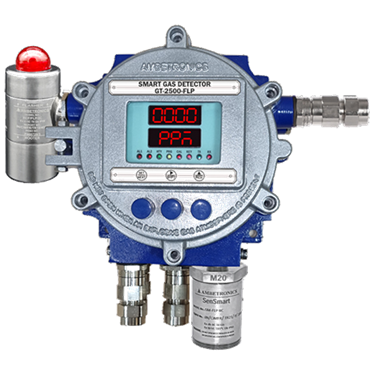
Smart Gas Detectors are a flameproof, PESO Certified Gas Detector designed for swift and reliable detection of Oxygen, Toxic, Combustible, and Volatile Organic Compounds (VOC) gas leaks.
Featuring an 8 x 2 Alphanumeric LCD with configurable backlit and 8 LEDs for status indication, it provides a clear digital display of gas concentration. This device offers a standard 4-20mA signal output with a configurable range and three relay outputs with a 5A rating.
Optional Isolated RS-485 Communication Port with MODBUS RTU PROTOCOL enhances connectivity. With a hot-swappable gas sensor module, the detector ensures easy maintenance, storing calibration data, alarm data, offset data, and output current data in the sensor module. Non-intrusive programming for the Flameproof Model is facilitated using a Magnetic Wand. The detector is capable of detecting gas concentrations down to PPM, %V/V, %LEL, and mg/m³, with indications for ‘Sensor Open,’ ‘Over Range,’ ‘Sensor Replace,’ ‘Cal Due,’ ‘Cal Fail,’ and mA Loop Open for comprehensive monitoring.
Particulate Matter Monitor (CAAQMS)
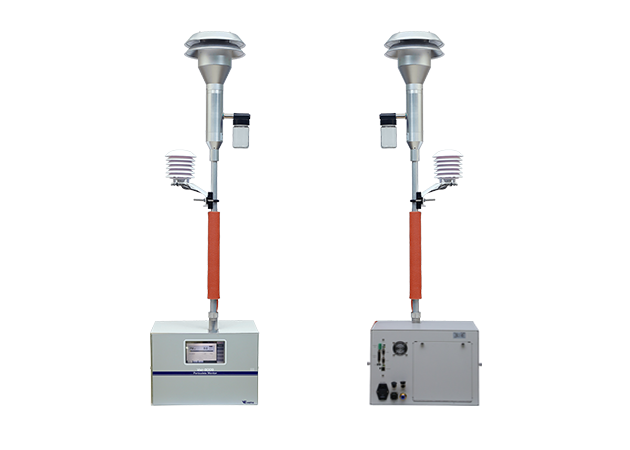
The PM Monitor is a digital device designed for continuous, real-time assessment of airborne particulate concentrations using beta radiation technology.
Which operates by collecting fine particles from the surrounding air onto a glass fiber tape and performs measurements every hour with high precision. Its in-line sampling configuration enables simultaneous particle collection and beta attenuation analysis, ensuring uninterrupted environmental monitoring throughout the day. This design enhances the accuracy and responsiveness of concentration readings over short time intervals.
The system maintains the measurement chamber at a stable temperature slightly above ambient conditions, reducing errors caused by moisture or the evaporation of semi-volatile particles. By eliminating the need for costly dryers, the design increases measurement reliability while keeping operational expenses low. Additionally, the monitoring unit is built within a compact, insulated housing that requires no air conditioning or flow-splitting mechanism, simplifying upkeep and minimizing energy consumption.
Lightweight construction allows each module—none exceeding ~19 kilograms (40 pounds)—to be easily handled and transported. Its detachable pump assembly and portable housing make it ideal for field deployment in remote or space-limited areas where permanent shelters are impractical. The user-friendly setup process enables full system operation in under 10 minutes.
Ambient Gas Analyzer
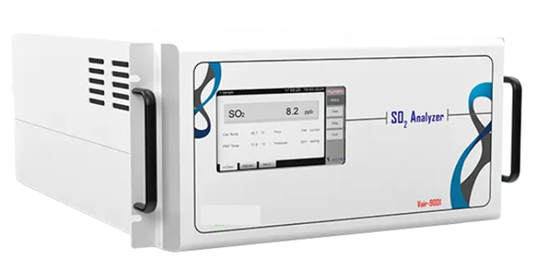
Ambient gas analyzers are specialized instruments used to measure the concentration of gaseous pollutants.
pollutants such as sulfur dioxide (SO₂), nitrogen oxides (NO and NO₂, collectively NOₓ), ozone (O₃), carbon monoxide (CO), and other trace gases present in outdoor air. These devices form the core of continuous ambient air quality monitoring systems deployed by regulatory agencies, industries, and research organizations to assess pollution levels and ensure compliance with air quality standards. Because they operate continuously and with high sensitivity, they allow authorities to track both long‑term trends and short‑term pollution episodes.
Key target gases
Typical ambient gas monitoring networks focus on a core set of pollutants defined by environmental regulations. SO₂ is measured to evaluate impacts from combustion of sulfur‑containing fuels and industrial processes. NO and NO₂ are monitored as indicators of traffic emissions and combustion sources, with total NOₓ used to understand photochemical smog formation. Ozone, a secondary pollutant formed in the atmosphere from NOₓ and volatile organic compounds under sunlight, is tracked due to its respiratory and ecological impacts. CO monitoring provides information on incomplete combustion from vehicles and other fuel‑burning activities, especially in urban and roadside environments. Additional gases such as CO₂, H₂S, NH₃, or VOCs may also be measured in specialized stations, depending on local regulatory or research needs.